
The History of the Wedding Ceremony
Today, weddings are seen as a celebration of beauty, flowers, and heartfelt promises. However, if we break down a modern ceremony into its details, we find that almost every gesture—from exchanging rings to cutting the cake—has roots that stretch back thousands of years. It has been a long journey: from strict tribal contracts to the moment when the main event becomes a sincere marriage proposal and the choice of one’s partner.
When Marriage Was a Matter of Survival
In ancient times, weddings had nothing to do with romance. It was a union not of two people, but of two clans. The main goal was practical: to unite lands and resources or to end a war between tribes. Marriage was considered an important agreement that had to be sealed with rituals so that it would have legal and magical power.
For example, in Ancient Rome, for a marriage to be considered legal, the presence of at least ten witnesses was required. These were not just guests—they served as living “notaries” who confirmed the fact that the contract had been concluded. From this same strict logic arose customs that today seem like nothing more than a game:
- Bride kidnapping: in the past, this was no entertainment. In times when tribes were at war, “abducting” a girl was a real way to obtain a wife without paying a huge ransom to her parents.
- The ransom as a test: this was a way to verify whether a man was worthy of such a “valuable asset.” The groom had to prove that he was strong and wealthy enough to provide for his new family.
- Carrying her over the threshold: the threshold was considered the boundary between worlds. In Rome, it was believed that the spirits of ancestors lived there. To ensure the “guardians of the home” did not perceive the new woman as an intruder, the man carried her in his arms, as if she had long been a part of this space.
- Slavic towel: the embroidered towel was seen as a “path” along which the couple symbolically entered their new life. It was a magical talisman that united the two families into a single lineage.
Since people back then believed in magic, every step was accompanied by protective rituals. A shared meal served as proof that the families were now “of the same blood,” while loud singing was meant to scare away evil spirits. Today, traditional feasts often take on more intimate formats, returning the celebration to its original intimacy and closeness.
Secrets of the Origins of Key Attributes
Most of the things we take for granted once had a completely different, often practical or protective meaning.
Wedding rings and the “vein of love”
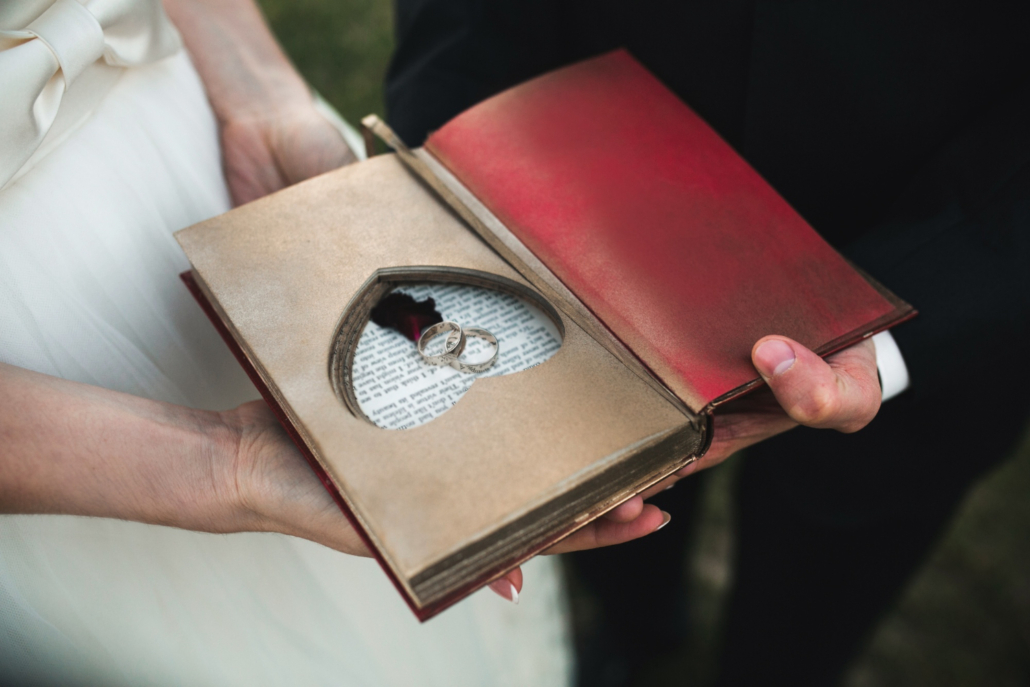
The tradition of exchanging rings originated in Ancient Egypt. For the Egyptians, the circle was a symbol of infinity, and the hole in the middle—a gateway to a new life. In ancient times, it was believed that a thin artery ran through the ring finger of the left hand, leading straight to the heart. It was called the “Vena Amoris” or “vein of love.” At first, rings were woven from reeds, and only later were they made of gold—the metal of the sun, which does not rust, just like true feelings.
The white dress: from Greek joy to royal fashion
For a long time, white was not a requirement. In Ancient Greece, brides used white fabrics simply as a symbol of light and joy. Later, girls would wear their best dress in any bright color. Everything changed in 1840 thanks to Queen Victoria of England. She got married in a luxurious white dress with lace. Before her, white was considered the color of mourning or immense wealth, but after her wedding, every girl began to dream of the “queen’s look.”
The veil and bouquet—protection for the bride
In the past, the bride was considered very vulnerable to the evil eye, so the veil was thick and long—it literally hid the girl from evil eyes until the ceremony was over. The bouquet served a similar purpose. In ancient times, it wasn’t supposed to be beautiful. Brides carried bunches of garlic, dill, and wormwood, as it was believed that evil spirits couldn’t stand strong smells. The tradition of tossing the bouquet originated in France. Previously, guests would try to tear a piece from the bride’s dress “for good luck.” To keep the dress intact, brides began tossing the bouquet, distracting the crowd and making a quick escape.
Wedding cake: from bread to sweet towers
The tradition of the dessert began with bread. Among the Slavs, the wedding loaf was a symbol of the sun and fertility. In Ancient Rome, a barley flatbread was broken over the bride’s head, and guests collected the crumbs “for good luck.” The multi-tiered cake emerged in England. Guests brought small buns and stacked them into a tall pyramid. The newlyweds had to kiss over this mountain without knocking it down. If they succeeded, the marriage promised to be prosperous.
Evolution into the Modern Era—From Rules to Meaning
Over the centuries, weddings became less “magical” and more aesthetic. In the 12th century, the church made marriage a sacred sacrament, moving ceremonies from the doorsteps of homes to the altar. This added the solemnity to the event that we know today. The ancient Greek tradition of the “hen party”—a ritual bath before the wedding—has transformed into modern parties with friends.
In England, the tradition of “something old, something new, something borrowed, and something blue” was born, which has become popular worldwide. It is like symbolic baggage that a woman takes from her past life into the future. Modern wedding planning today is not just about sticking to a schedule, but a delicate work with meanings, where the couple chooses only those details that resonate with them.
Today’s traditions are a way to add a special atmosphere to the day. Honeymoons, which were once a time when the couple simply hid from relatives, have now become a symbol of a romantic start. Every element of a modern celebration, from the choice of location to the smallest decor, has its own rich history that continues with each new couple.
FAQ: Frequently Asked Questions and Answers
Why do the witnesses often dress alike?
This is an ancient Roman custom. The newlyweds’ friends would dress similarly to them to confuse evil spirits. The spirits couldn’t figure out exactly who was getting married that day.
Where does the name “Honeymoon” come from?
In ancient times, newlyweds were supposed to drink a honey-based beverage during the first month after the wedding. It was believed that this would make their feelings sweet and their future children healthy.
Why do they cut the cake together?
It is a symbol of their first joint effort. In the past, the bride cut the cake herself, but when cakes became multi-tiered and hard, she needed her husband’s help.
Why do they smash dishes at a wedding?
It was once believed that the loud noise would scare away evil spirits. A broken glass also symbolized a “point of no return”: just as the shards cannot be put back together, so the marriage must be unbreakable.
Why are wedding rings usually made of gold?
Gold symbolizes the sun. It does not fade over time, which perfectly reflects the idea of the eternity of the relationship and the purity of intentions.

